Why Most Transformations Don’t Fail Because of Strategy
And why sustainable change requires alignment, momentum and adoption.
Walk into almost any transformation programme and you’ll find no shortage of ambition.
- The strategy is clear.
- The objectives are defined.
- The business case is approved.
- The technology has been selected.
And yet, many transformation efforts struggle to deliver the expected results.
Not because the strategy was wrong.
But because change is rarely a strategy problem.
More often, it is an execution problem. Or an adoption problem. Or a combination of both.
Over the years, I have worked with organizations navigating growth, restructuring, operational improvement, digital transformation and cultural change. While every situation is unique, one observation keeps returning:
Organizations tend to focus on one aspect of change while underestimating the others.
Some focus on structures, governance and processes.
Others invest heavily in communication and leadership.
Many concentrate on training people and managing resistance.
All are important.
None are sufficient on their own.
The Three Conditions for Sustainable Change
Successful transformation requires progress on three interconnected levels.
1. The Organization Must Be Aligned
Many transformation efforts begin by defining a future state.
Far fewer take the time to assess whether the organization is actually configured to support it.
Strategy may point in one direction while incentives point in another.
Processes may support yesterday’s priorities.
Capabilities may not yet exist.
Governance structures may unintentionally slow down decision making.
This is why I continue to value the McKinsey 7S framework.
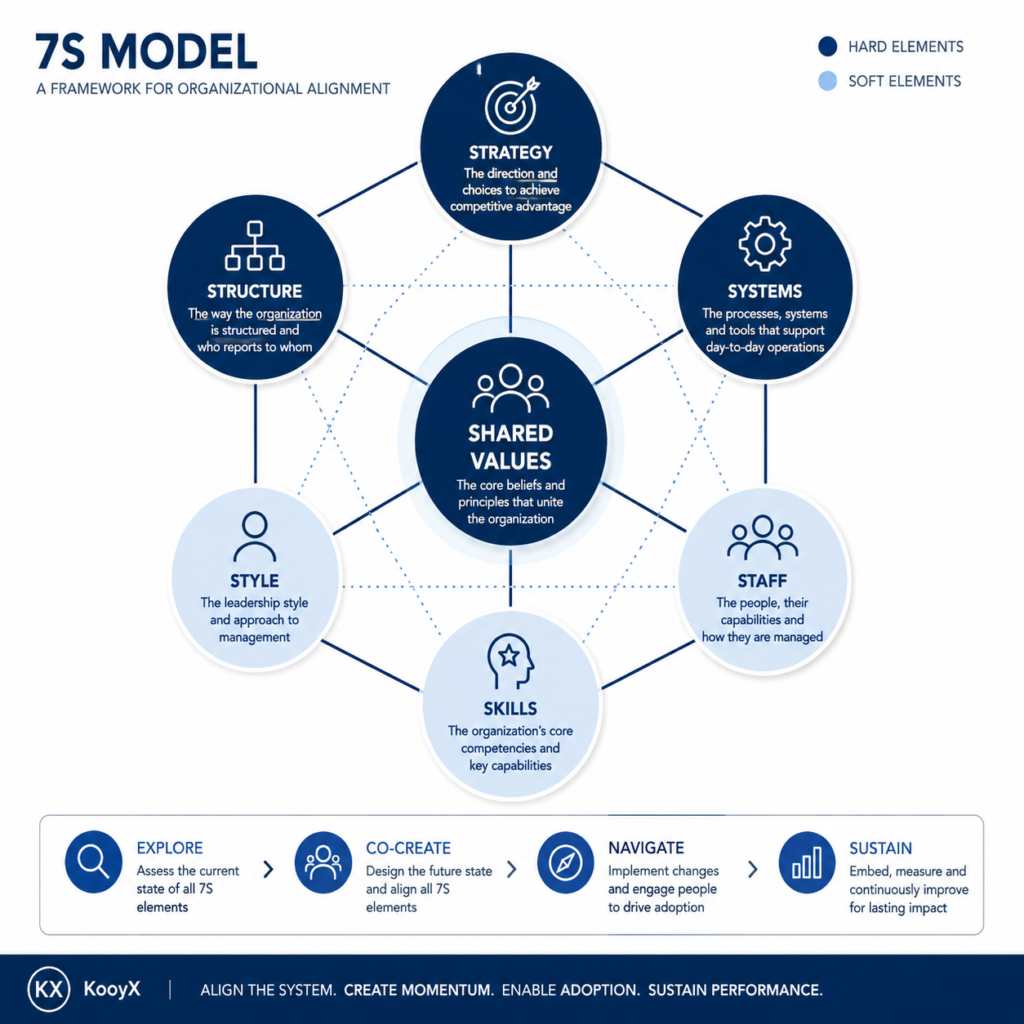
Not because it provides all the answers, but because it forces us to look at the organization as a system.
- Strategy.
- Structure.
- Systems.
- Shared Values.
- Style.
- Staff.
- Skills.
When these elements pull in different directions, transformation becomes an uphill battle.
Alignment creates the foundation for change.
2. Change Needs Momentum
Even a perfectly aligned organization will not change itself.
People need a reason to move.
They need confidence in the future.
They need visible leadership.
This is where Kotter’s work remains highly relevant.
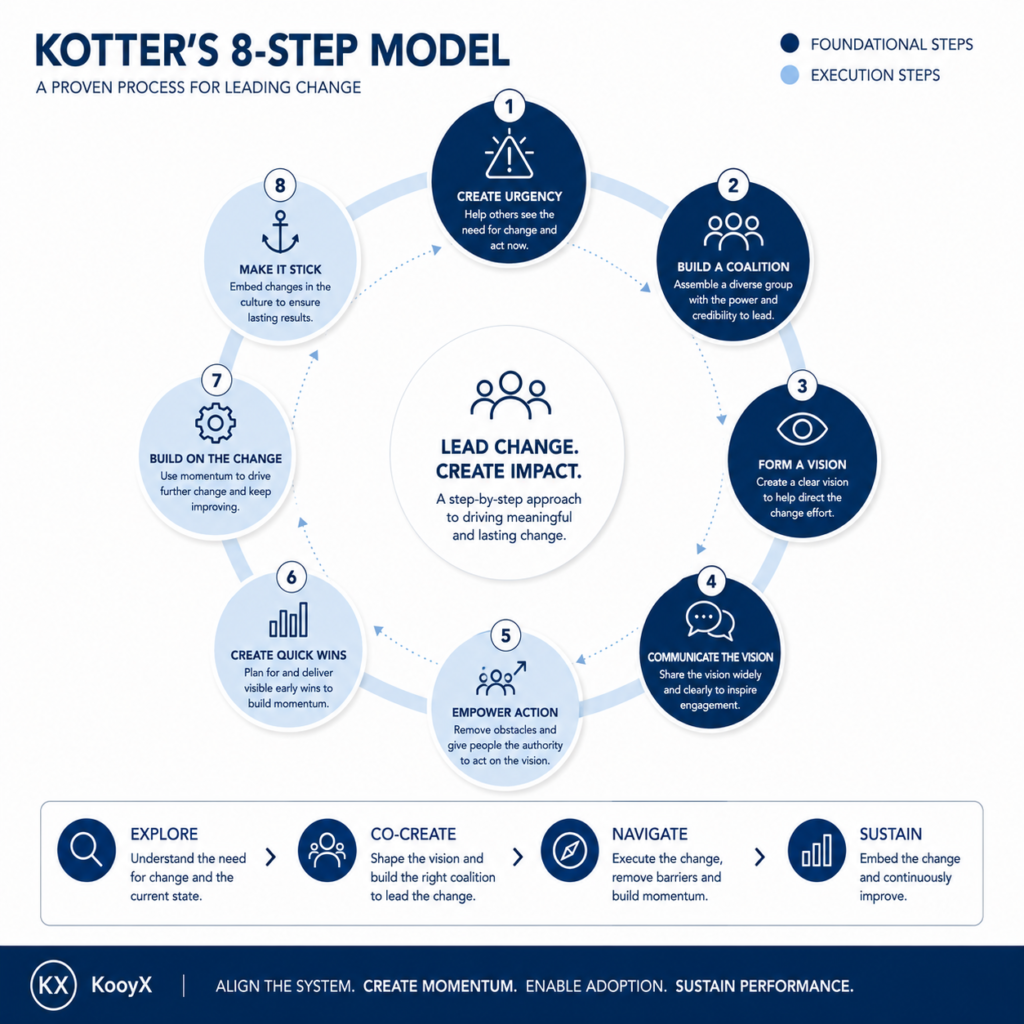
The strength of Kotter’s model lies in recognizing that transformation is not simply a project plan.
It is a leadership challenge.
Progress depends on creating energy, commitment and belief across the organization.
Without momentum, even the best-designed transformation loses speed.
3. People Must Adopt the Change
Organizations do not change.
People do.
Every transformation ultimately succeeds or fails through thousands of individual decisions made every day.
Do people understand why change is needed?
Do they want to support it?
Do they know what to do differently?
Can they perform in the new environment?
Will new behaviours be reinforced?
These questions sit at the heart of ADKAR.
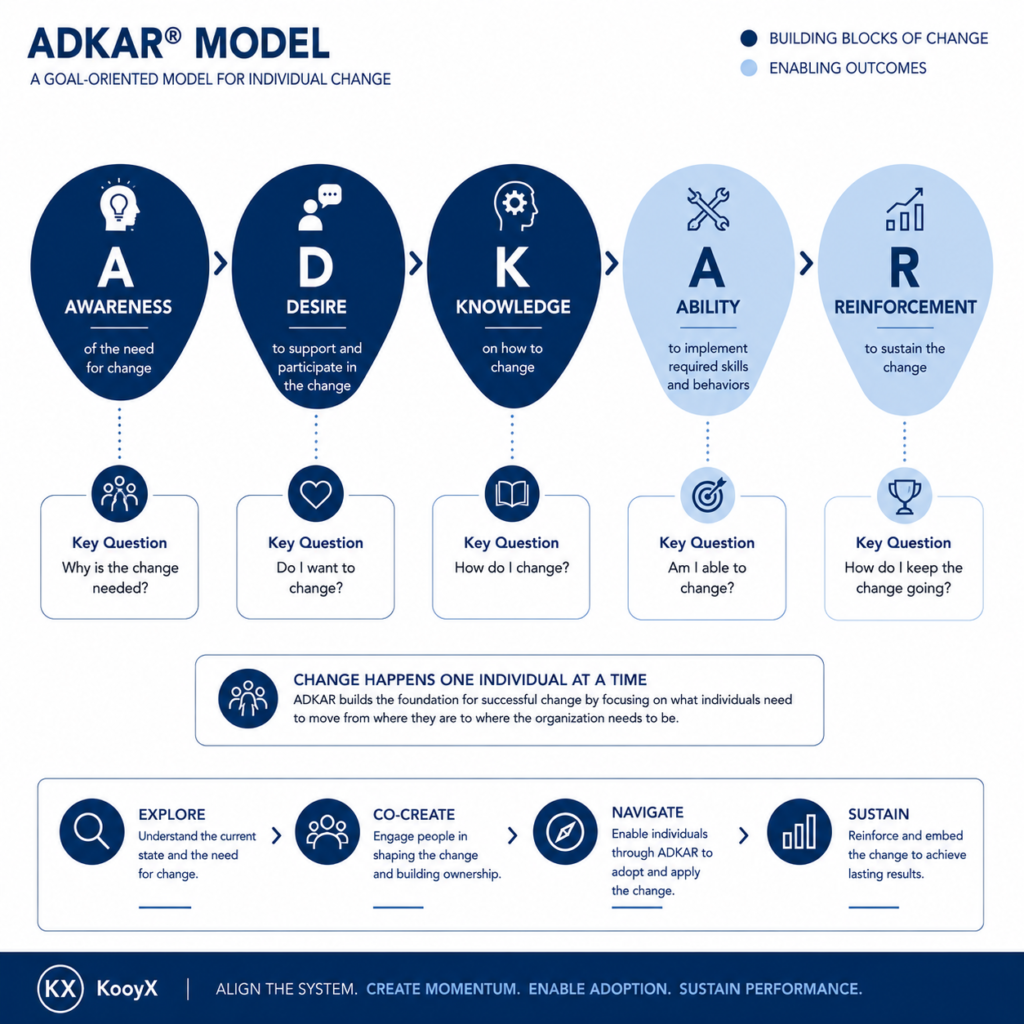
In my experience, this is often where transformation programmes encounter their greatest challenge.
Not because people resist change.
But because organizations frequently underestimate the effort required to help people move from awareness to sustained behaviour.
Adoption is not an event.
It is a journey.
Connecting the Dots
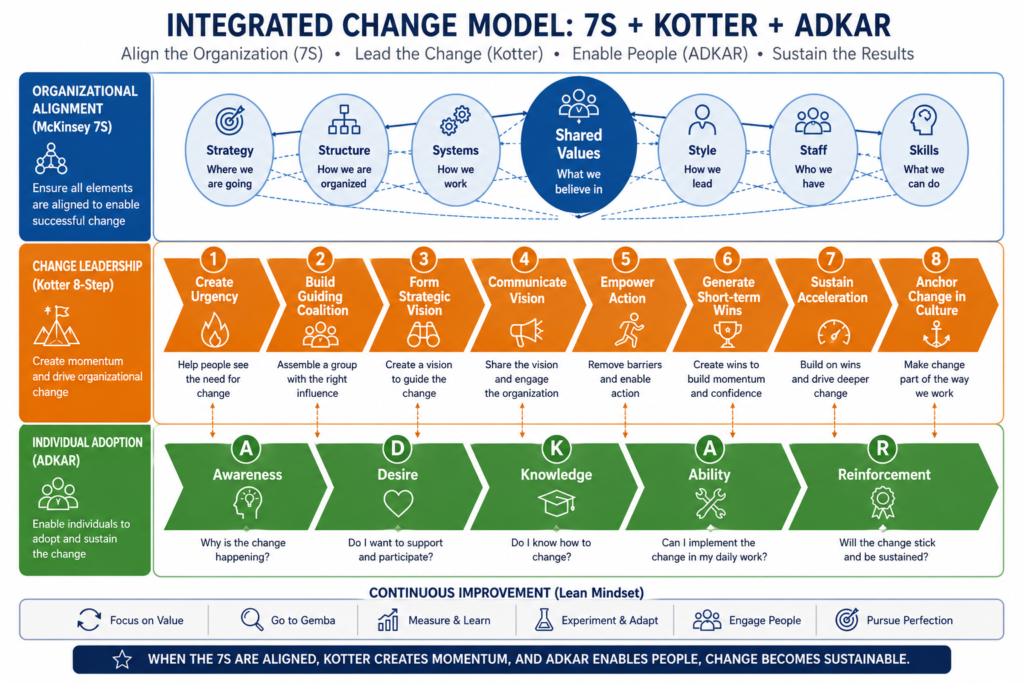
The more transformation programmes I encounter, the more convinced I become that sustainable change requires all three perspectives.
Alignment.
Momentum.
Adoption.
Each answers a different question.
| Question | Perspective |
|---|---|
| Are we organized to succeed? | McKinsey 7S |
| Can we create momentum? | Kotter |
| Will people actually change? | ADKAR |
Viewed together, they provide a more complete picture of transformation.
One that acknowledges both business performance and human behaviour.
One that connects strategy with execution.
One that increases the likelihood that change will last.
One More Thing
There is a final ingredient that often receives too little attention.
Learning.
No transformation unfolds exactly as planned.
Markets change.
Customers change.
Organizations learn.
Which is why I believe every transformation should be underpinned by a mindset of continuous improvement.
Go and see.
Measure and learn.
Experiment and adapt.
Engage people.
Improve continuously.
Transformation is not a destination.
It is an organizational capability.
Closing Thought
Many organizations ask whether they should focus on structure, leadership or people.
My experience is that this is the wrong question.
The real question is:
How do we connect them?
Because transformation becomes sustainable when strategy, execution and people move in the same direction.
And that is where real change begins!
0 Comments